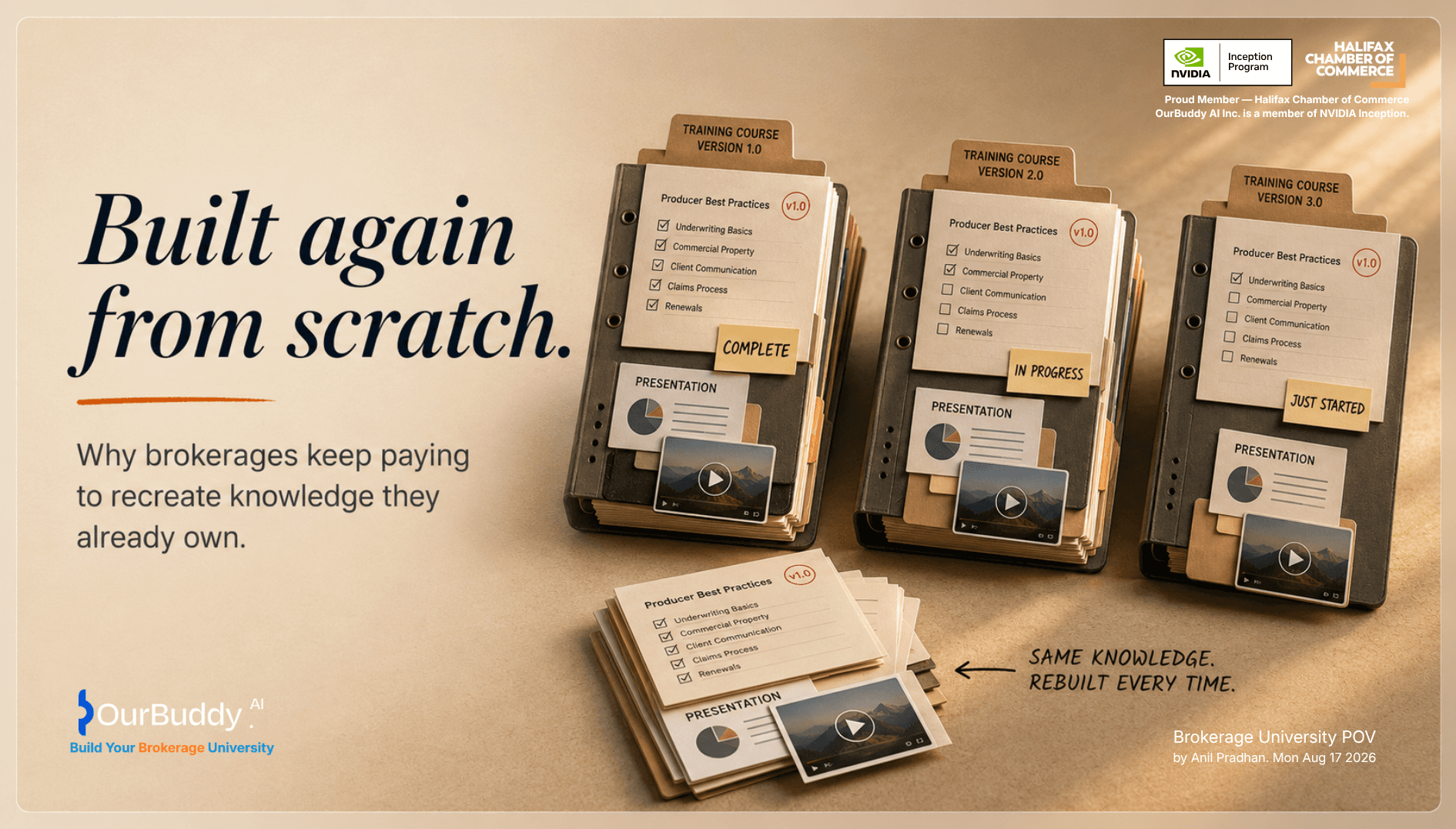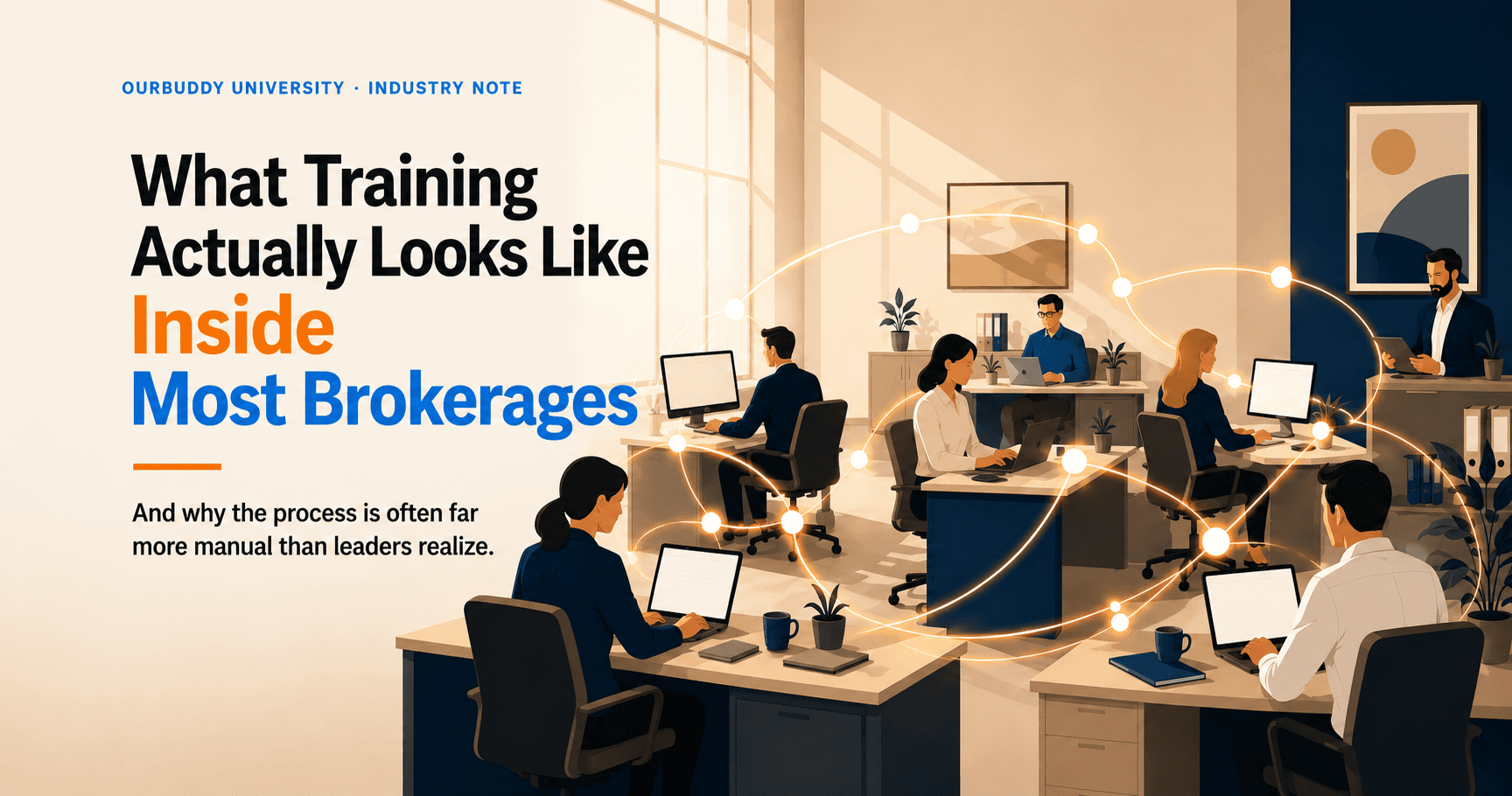

The industry is right to focus on talent, retention, and upskilling. But in many brokerages, the deeper constraint is not lack of content or lack of caring. It is the time and effort required to turn brokerage knowledge into structured, usable training.
By Anil Pradhan
Topic: Brokerage University POV / Brokerage Operations
Canadian brokerages are under growing pressure to develop people faster and more consistently. But while the industry often talks about hiring, retention, and education, many firms still face a quieter operational bottleneck: training build-time. SOPs, recordings, PDFs, checklists, and experienced staff knowledge may already exist, yet turning that into structured, repeatable learning still takes too long. That delay slows ramp-up, drains SMEs, and weakens consistency across the business.
The industry is right to focus on talent
The Canadian brokerage industry is not imagining this problem.
Talent pressure is real. So is the pressure to upskill faster.
Public industry conversation in 2026 is clearly pointing in that direction. Canadian Underwriter has reported that brokers across Canada are recognizing the need to upskill and reskill faster, especially as retirements increase and regulatory, customer, and risk complexity continue to rise. At the same time, broker associations are actively refreshing learning pathways and education formats.
That part is not controversial.
What gets missed more often is this:
Many brokerages do not only have a training delivery problem.
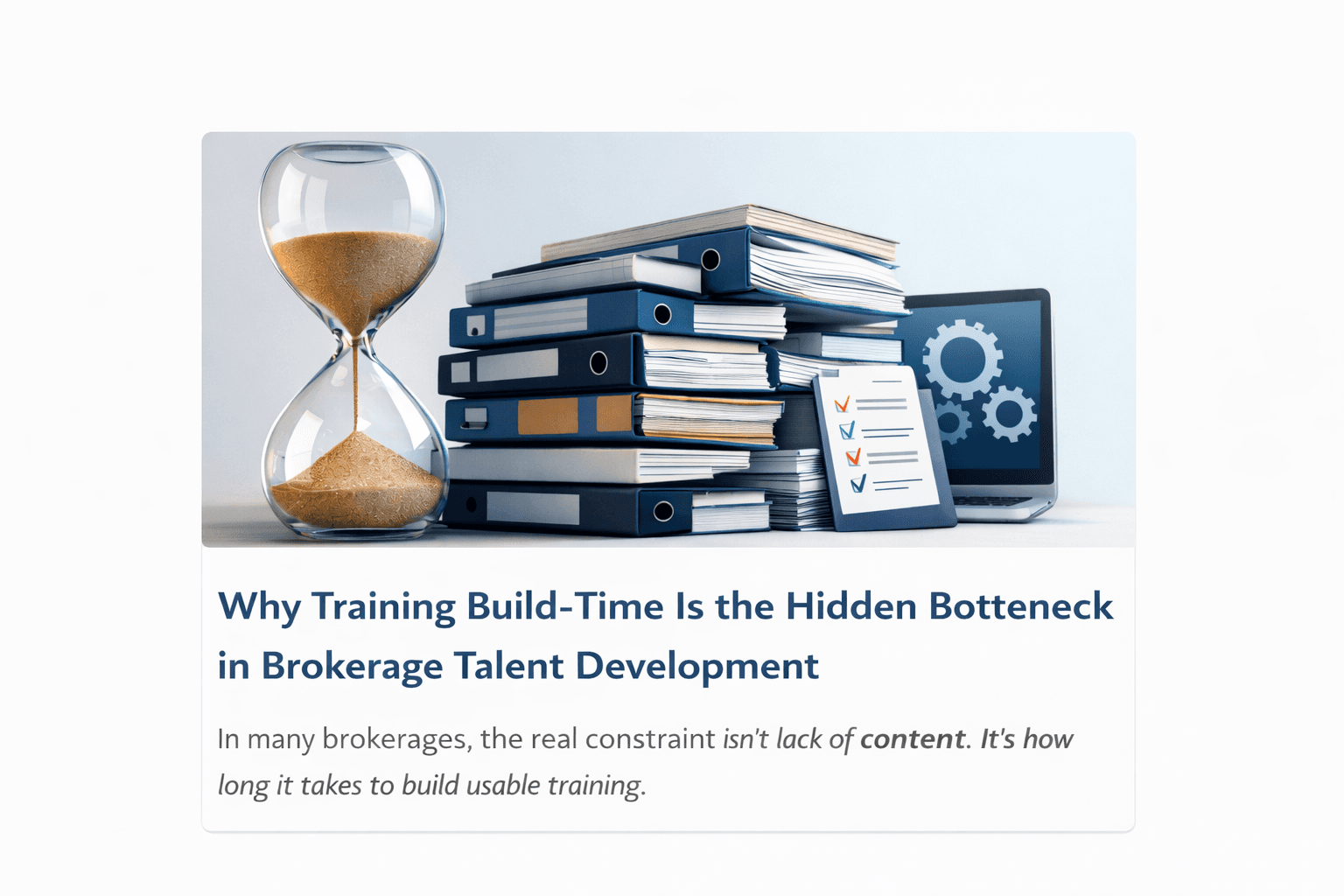
They have a training build-time problem.
The quieter bottleneck inside brokerages
In a lot of brokerages, the raw material for good training already exists.
It may live in: SOPs, checklists, PDFs, recorded meetings or walkthroughs, shadowing habits, manager notes, team-specific workflows, the heads of experienced staff who know exactly how things should be done.
So the issue is not always that the brokerage knows too little.
The issue is that turning what it already knows into clean, structured, assignable learning takes too long.
That is the hidden bottleneck.
Because if every meaningful training effort becomes a side project that takes weeks or months to build, then development will always lag behind what the business actually needs.
Not because leaders do not care.
Not because trainers are weak.
Not because the team is lazy.
But because the conversion process from brokerage knowledge to usable training is still too slow.
Why build-time matters more than it sounds
“Build-time” can sound like a back-office problem.
It is not.
It has direct operational consequences.
When training takes too long to create, several things happen:
- new hires wait too long for clear, structured support
- SMEs keep repeating the same explanations live
- managers become the fallback training system
- branch or desk-level inconsistency keeps spreading
- important updates take longer to land across the team
- good content stays trapped in raw form instead of becoming usable learning
That means the brokerage may already have the ingredients for stronger talent development, but not the operating capacity to package and deploy them fast enough.
This is one reason talent development often feels harder than it should.
The issue is not always “we do not know what to teach.”
Sometimes it is simply “we cannot turn what we know into real training quickly enough.”
This is where talent development quietly breaks down
The industry often talks about the talent problem in terms of hiring, retention, and culture.
Those things matter.
But inside a brokerage, development tends to break down much earlier and much more practically.
It breaks down when:
- a good process exists, but only two people can explain it well
- a new hire gets a different version of the standard depending on who trained them
- a recorded session sits unused because no one has time to structure it
- compliance, workflow, or product updates arrive faster than the team can operationalize them
- leaders want consistency, but the build effort required to create that consistency is too high
This is why training build-time deserves more attention.
It is not just a content-production issue.
It is a capability issue.
If the business cannot turn its own knowledge into repeatable learning at speed, then the brokerage will stay too dependent on human memory, availability, and repetition.
The brokerages that win will reduce the drag
The brokerages that handle this era well will not only be the ones that care about development.
Many already do.
The ones that pull ahead will be the ones that reduce the internal drag involved in building meaningful training.
That means making it easier to go from:
- source material to first draft
- SME know-how to structured modules
- process update to assigned learning
- tribal knowledge to reusable internal standards
In other words, the speed of training creation is becoming part of the competitive advantage.
Because the faster a brokerage can turn what it already knows into trackable, usable learning, the faster it can:
- ramp people
- reduce repeat interruption
- reinforce standards
- respond to change
- preserve institutional knowledge
- create a more consistent employee experience
Why this matters now
This matters more in 2026 because the environment is not getting simpler.
Canadian Underwriter’s recent coverage points to the same broader reality: brokerages are facing growing pressure to prepare people faster for a more complex market, and broker talent remains a live strategic issue. IBAO’s 2026 education updates and Ontario reform-related training also show that the pace of learning demand is not slowing down.
So the question is no longer just whether training matters.
It does.
The sharper question is whether the brokerage has a practical way to build training quickly enough to keep up.
That is where many good intentions still hit the wall.
The shift brokerages may need to make
A lot of firms still think about training as delivery.
But the bigger bottleneck is often creation.
Not just running training.
Building it.
Packaging it.
Structuring it.
Keeping it current.
Making it repeatable.
That is why the conversation needs to expand.
Not only: “How do we train people better?”
But also: “How do we dramatically reduce the time and effort it takes to turn brokerage knowledge into usable training?”
That is where a lot of the hidden leverage sits.
And that is one reason the idea of a Brokerage University matters.
Not because it sounds good.
But because brokerages need a more practical internal system for turning what they already know into something that can actually scale.
Closing thought
The talent challenge in Canadian brokerages is real.
But in many firms, the quieter constraint is not willingness.
It is build-time.
The time it takes to move from scattered knowledge to structured learning.
From good people to repeatable development.
From “we know this internally” to “we can teach this reliably across the business.”
That is the bottleneck more brokerages will need to confront.
Because when training takes too long to build, talent development slows down with it.
And when talent development slows down, everything else gets harder.
About the Author
Anil Pradhan is the Founder and CEO of OurBuddy.ai. With 20+ years of experience across multiple countries and industries, including Canadian P&C brokerage, customer-facing, technology, and operational leadership roles, he writes about how brokerages can standardize learning, reduce training drag, and build people-development systems that scale.