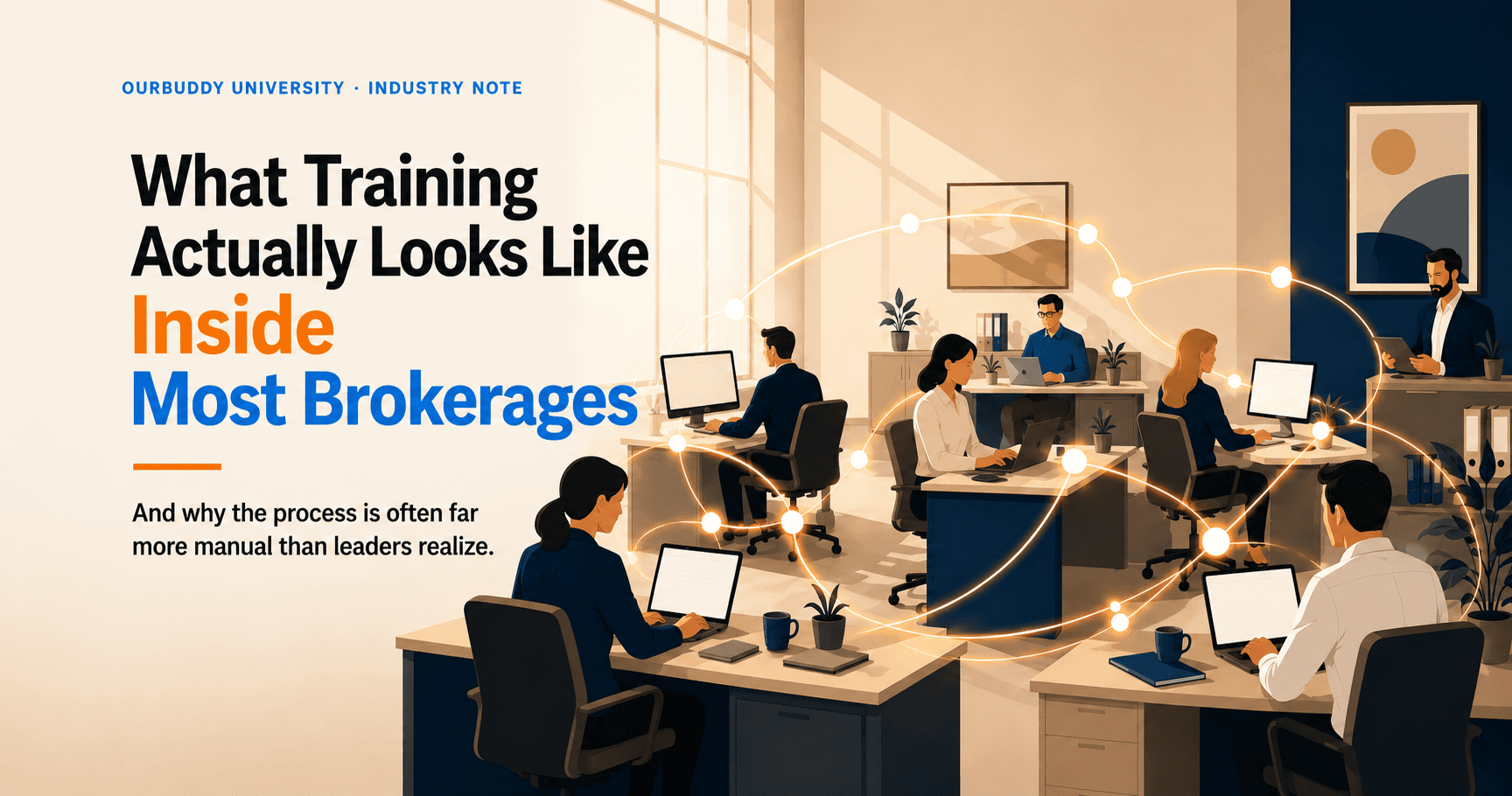

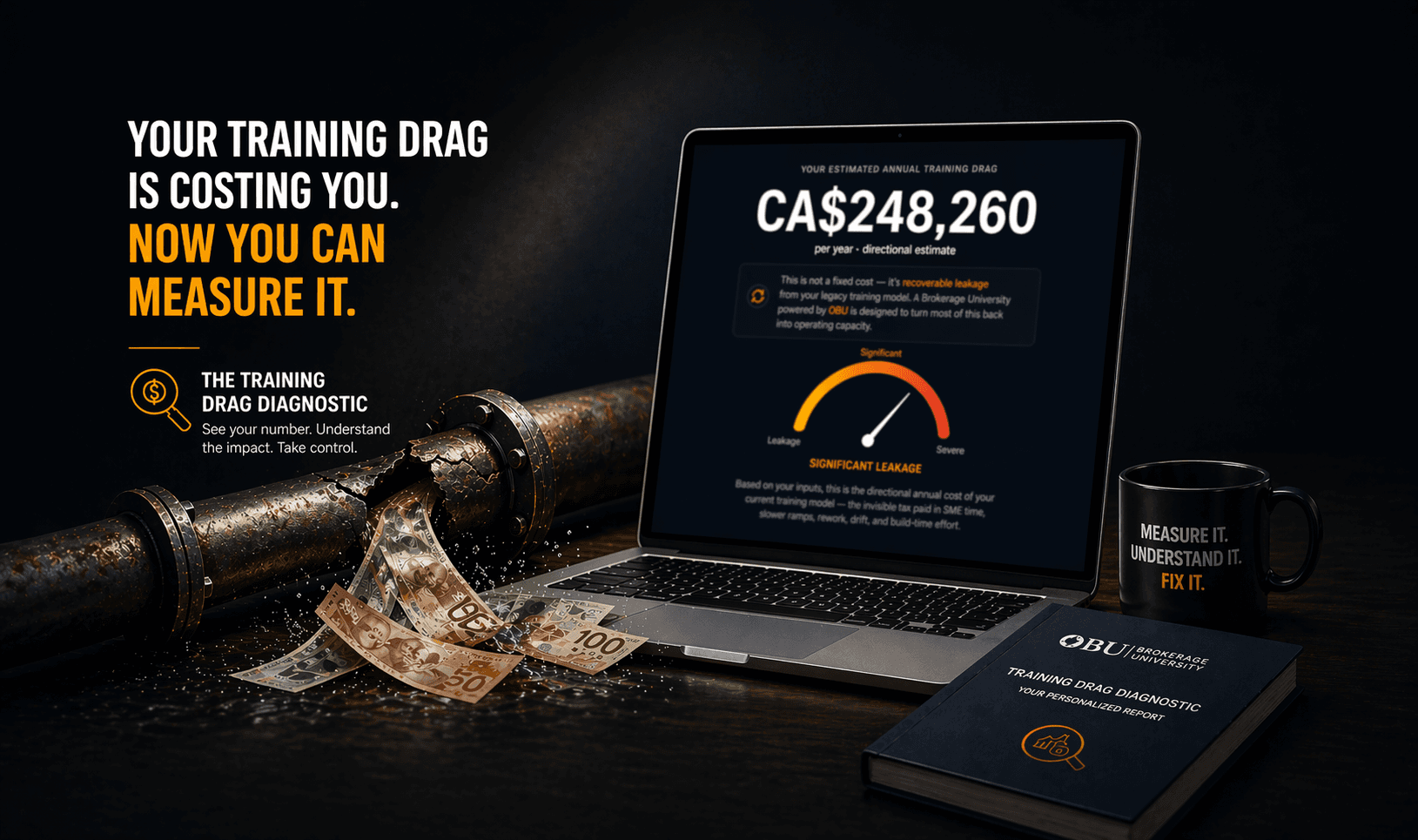
Estimate whether your hidden training drag has already crossed six figures.
Nothing Feels Broken — And That’s the Problem
In most brokerages, nothing feels obviously broken about training.
People are getting trained. Sessions are happening. New hires are learning. Questions are being answered. From the outside, the system appears to be working as expected.
But that surface-level stability often hides a more uncomfortable reality.
A training model can appear functional while quietly creating a steady stream of inefficiencies underneath. These inefficiencies rarely show up as urgent issues. Instead, they accumulate slowly—across people, across teams, and across time—without ever being isolated or measured as a single cost.
And that is precisely why they persist.
The Cost That Doesn’t Show Up on a Financial Statement
Brokerages are generally disciplined when it comes to tracking performance. Compensation is monitored, revenue per employee is analyzed, and expense ratios are reviewed regularly.
But the cost of how training actually happens inside the business is rarely examined with the same rigor.
Not because it is insignificant, but because it is not visible in a single place.
It is paid in hours rather than invoices. It is absorbed into daily operations. It is distributed across multiple roles—senior brokers, managers, trainers, and new hires—each contributing small amounts of time that never get consolidated into a measurable figure.
The result is a cost structure that is real, recurring, and often substantial, yet largely invisible.
Why This Matters More Than It Seems
If your current training approach relies heavily on manual coordination, repeated explanations, and slow content creation cycles, then the cost is not hypothetical. It is already present within your operations.
It appears in the time experienced brokers spend answering the same questions repeatedly. It appears in the extended ramp time required for new hires to become fully independent. It appears in the supervision, corrections, and rework that continue even after training is considered “complete.”
Individually, these moments may not seem significant. Collectively, they represent a consistent drain on productivity.
More importantly, this cost compounds. It does not occur once and disappear. It repeats—quietly but persistently—every week the current model remains in place.
What Training Often Looks Like in Practice
In many brokerages, training begins reactively. A new hire joins, a workflow changes, or a carrier update arrives. Someone is then responsible for gathering relevant materials—SOPs, PDFs, recordings, internal notes, and guidance from experienced staff.
This process alone can take days or weeks, particularly when information is scattered or undocumented.
Once gathered, the material must be interpreted, structured, and packaged into something usable. This may involve building slides, coordinating with subject matter experts, or waiting for key individuals to find time in already busy schedules.
Training is then delivered, often as a one-time session or event. Attendance may be tracked, feedback may be collected, and follow-up may occur. Then the organization moves on—until the next need arises, and the process begins again.
This cycle feels familiar because it is common. But familiarity should not be mistaken for efficiency.
Understanding Training Drag
What accumulates inside this model is what can be described as training drag.
Training drag is not a single failure or breakdown. It is the cumulative effect of small, repeated inefficiencies embedded in how training is created, delivered, and maintained.
It includes the repeated interruption of experienced staff, the slower-than-necessary path to competence for new hires, the ongoing need for supervision and correction, and the effort required to rebuild or update training materials each time something changes.
None of these elements are unusual on their own. However, when they occur continuously across a growing organization, they form a meaningful layer of operational cost.
The Two Layers Most Brokerages Carry
Beneath this dynamic, there are typically two overlapping layers of cost.
The first is delivery drag—the ongoing burden that persists after training exists. This includes repeated questions, inconsistent learning outcomes, supervision, and standard drift across teams or locations.
The second is build-time drag—the cost of creating training in the first place. This includes collecting source material, understanding it, structuring it, packaging it, and coordinating its delivery.
Most brokerages are not dealing with just one of these layers. They are carrying both simultaneously.
And if the organization hires regularly, operates across multiple teams or branches, or experiences ongoing change, this combined cost is unlikely to be trivial. It becomes an operational expense—one that simply never appears as a formal line item.
Why This Cost Often Goes Unmanaged
To address this gap, we built the Training Drag Diagnostic.
It is a directional tool designed to help brokerage leaders estimate how much hidden cost may already exist within their current training model. By looking at inputs such as hiring volume, ramp time, subject matter expert involvement, content build effort, and ongoing support load, the diagnostic provides an estimate of how this drag may be accumulating over time.
It is not intended to produce a precise financial calculation. Rather, it is designed to surface a cost pattern that is often felt but rarely quantified.
If your brokerage is actively hiring, scaling, or managing multiple teams, understanding this number is no longer optional.
You can estimate your current training drag here:

What Tends to Surprise Leaders Most
The most surprising insight is rarely tied to a single assumption.
Instead, it is the combined effect of multiple small factors. Slightly longer ramp times, incremental interruptions to senior staff, repeated effort in building training materials, and ongoing coordination each time something changes.
When these elements are viewed together, an otherwise ordinary training model can quickly reveal itself as a meaningful source of cost.
And once that becomes visible, the conversation shifts.
This Is Not About Effort
It is important to emphasize that this dynamic is not a reflection of inadequate effort.
In most brokerages, trainers, managers, and subject matter experts are working hard and doing what the current model requires of them. The issue is not the people within the system. It is the structure of the system itself.
Even highly capable teams can find themselves operating within a model that creates unnecessary friction.
What Changes When Training Becomes a System
When training becomes more structured, repeatable, and visible, the underlying cost dynamics begin to shift.
Knowledge can be packaged once and reused consistently. New hires can follow clearer, more predictable paths to competence. Experienced staff are interrupted less frequently for recurring issues. Updates can be deployed more quickly. Leadership gains better visibility into where readiness stands and where gaps still exist.
The goal is not to eliminate effort entirely. It is to ensure that effort contributes to scalable capability rather than recurring inefficiency.
A Better Question to Ask
Rather than asking whether training exists, a more useful question may be:
What is our current training model quietly costing us—every week, every month, and every year we leave it unchanged?
Because in many cases, that cost is already present.
The only question is whether it has been made visible.
Closing
Training will always require time, attention, and investment. However, the way that effort is structured determines whether it strengthens the organization over time or gradually erodes capacity through hidden inefficiencies.
If you want to understand whether your current model may already be carrying that hidden cost, the first step is simply to make it visible.
Run the Training Drag Diagnostic and see what your current training model may already be costing your brokerage:
About the Author
Anil Pradhan is the Founder and CEO of OurBuddy.ai. With 20+ years of experience across multiple countries and industries, including Canadian P&C brokerage, customer-facing, technology, and operational leadership roles, he writes about how brokerages can standardize learning, reduce training drag, and build people-development systems that scale.