

How your most experienced people quietly turn into the system everyone else runs on.
A commercial producer hits something unfamiliar on a file just before lunch. A wording that does not sit right, a class of risk they have not placed before. They do what everyone in the building does when this happens. They get up and walk over to the one person who always knows. Just a quick question, they say. It is never quick. And while that senior broker talks them through it, their own renewal sits open on the screen behind them, waiting.
The question got answered. The training tax just got paid, and no one wrote it down.
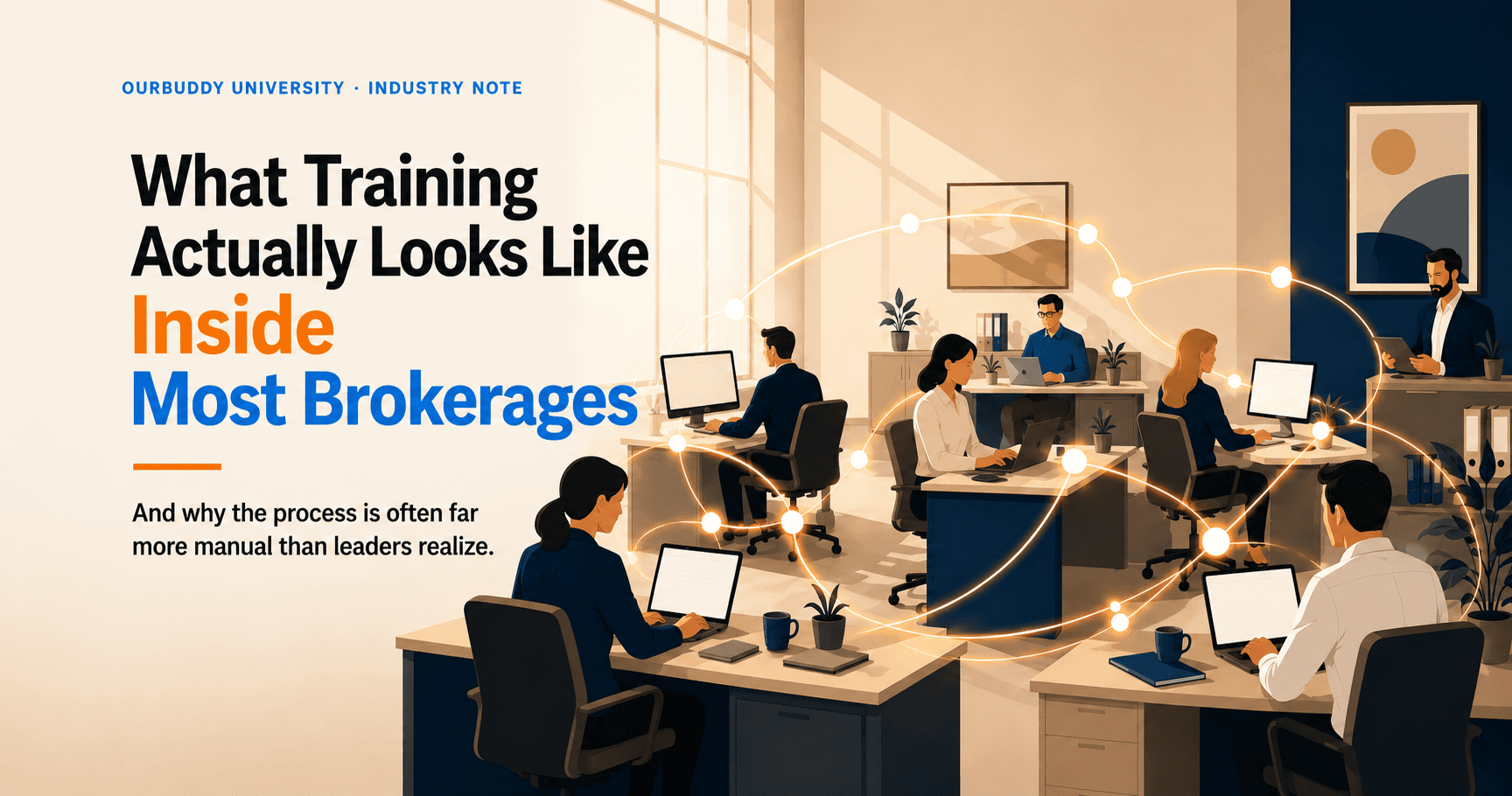
Every brokerage has that person. Often two or three. The one whose name comes up the moment something gets complicated. The owners we talk to tend to name that person before we even ask. New producers are told, in their first week, to just go ask them. Managers route the hard files their way without really thinking about it. When they take a week off, a small backlog forms that nobody quite predicted. Article 6 followed what training actually looks like inside most brokerages, step by manual step. This is the part sitting underneath all of it. Not the process. The people quietly holding the process up.
The person everyone goes to
That person is usually not in a training role. They are a senior broker, a technical lead, a long-tenured account manager, a principal who still touches files. Their job is production, or service, or leadership. Teaching other people just became something they absorbed along the way, because they are the ones who know.
It works, for a while. The knowledge is real, it is current, and it comes with judgment attached, which is more than any document offers. Asking a person is faster than finding a policy. So the whole building learns to ask. And the more reliable that person is, the more the building leans on them, until leaning on them stops looking like a choice and starts looking like how things are done.
None of that is a failure. It is a sign the brokerage has genuinely capable people, which is worth being proud of. It is just worth seeing clearly, because the thing holding the place together is also quietly carrying a cost.
What the interruptions actually cost
The cost hides because each instance is small. A two-minute question here, a quick review there, a walk-through for the new hire on Thursday. None of it lands on a report. But add it up across a week and the picture changes. The most experienced person in the building spends a real share of their time answering the same categories of question, pulled off their own work to do it. And every interruption carries a second cost on top of the minutes. Deep work on a complex placement does not resume the instant the conversation ends. It restarts.
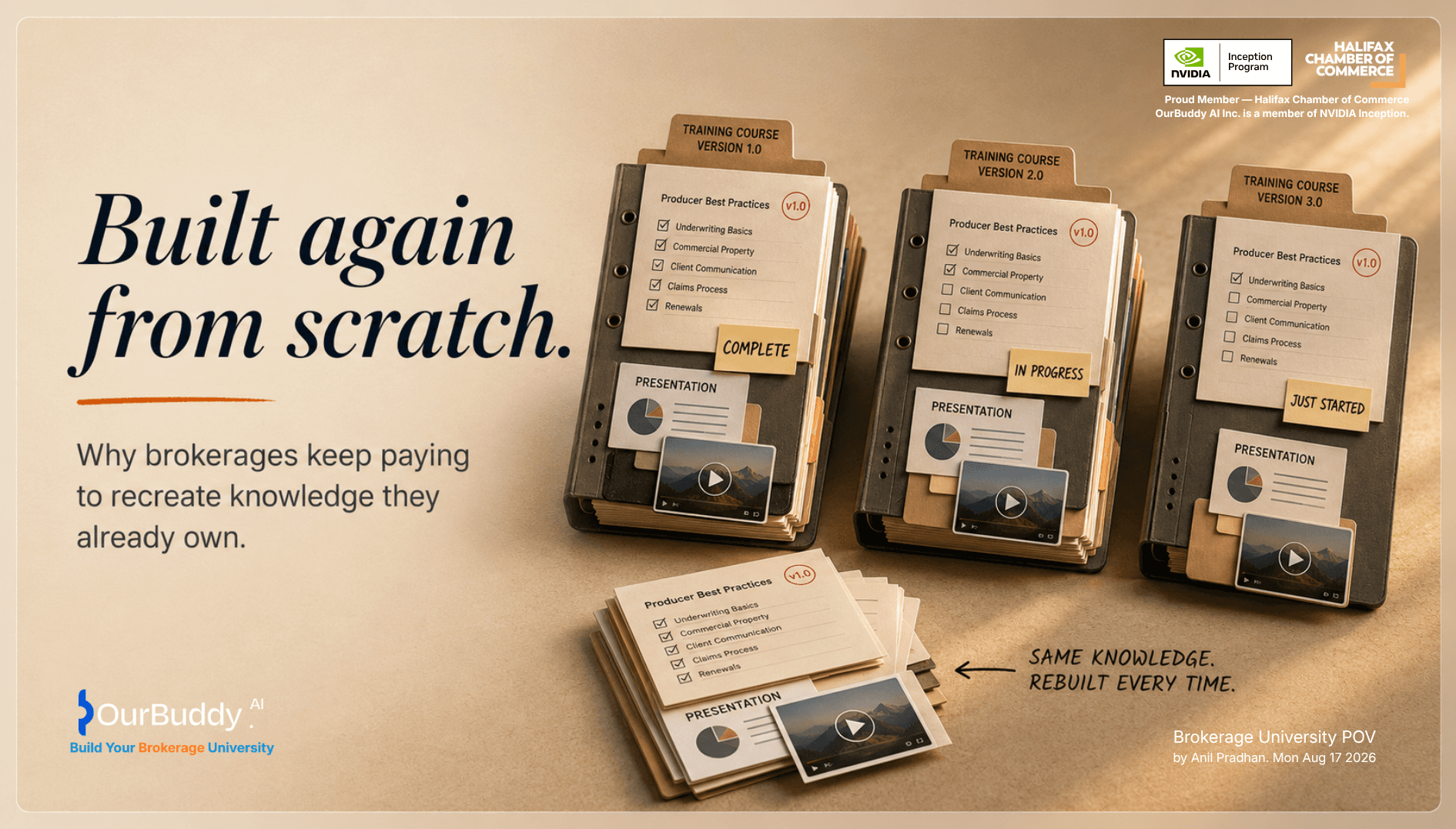
There is a quieter cost underneath that one. Because the knowledge lives in a person and moves by conversation, it comes out a little differently every time. The senior broker explains it well on a calm Tuesday and more briefly on a chaotic Friday. Two producers ask the same thing a month apart and walk away with two slightly different answers. Nothing gets captured. The next new hire starts the same cycle from the beginning. The brokerage ends up paying for the same knowledge to be delivered again and again, and never once owning it.
Why no one sees it
None of this shows up where leaders usually look. It does not read as a cost, because no one bills it. If anything, it reads as a strength. We have great people. Our seniors mentor the juniors. There is real truth in that. But it is also exactly why the dependency never gets examined.
A weakness gets attention. A strength that is quietly load-bearing does not.
Not, at least, until the day the person carrying it is out sick, buried in their own files, or gone. That last version is the one leaders feel most. When the person everyone asks finally retires or moves on, the shop does not just lose a headcount. It loses a system it never realized it was running. The questions do not stop. They simply have nowhere to go.
Why it gets heavier as the brokerage grows
At today's size, none of this feels urgent. The person is here, the questions get answered, the work ships. The strain shows up with growth. More producers, more branches, more products, more carriers, and every one of them eventually routes back to the same few heads. The expert who could comfortably carry a team of fifteen cannot carry a hundred and fifty. Not because they know any less, but because there are only so many hours in their day and only one of them.
The dependency that felt like a strength at one size quietly becomes a ceiling at the next. What that ceiling leads to as the business keeps growing, the same knowledge rebuilt in every new branch, the organization somehow moving slower the bigger it gets, is a longer story. The point here is the one sitting underneath all of it. The expertise only moves when a specific person stops what they are doing and hands it over, in person, one more time.
What it looks like when it works
It is worth picturing the other version, even briefly. The senior people are still the source of the knowledge. That does not change, and it should not. What changes is how it travels. Their expertise gets captured once, in their own words, and made reachable to everyone who needs it, so the fifth person with the same question does not have to interrupt them to get the answer. The expert spends their hours on the genuinely hard, genuinely new problems, which is the work only they can do. And the knowledge stops walking out the door every time someone does.
The difference is not that the experts matter less. It is that the brokerage stops depending on their availability to function.
Closing
Relying on experienced people is not a mistake. It is the most natural thing a brokerage does, and their knowledge is the most valuable thing in the building. The point is narrower than that. Leaning on human interruption as the way that knowledge moves is a decision, even when nobody remembers making it. And like the rest of the training process, its cost stays invisible precisely because it is spread across so many small moments and so many people's days.
If you want a directional sense of how much of your team's capacity is already being spent this way, you can put a number to it here:
Run the Training Drag Diagnostic to estimate what your current training model may already be costing your brokerage.
Run the Training Drag Diagnostic
With thanks
With thanks to the brokerage owners, operators, and frontline leaders across Canada whose conversations continue to shape this series, and in particular to those who named the reliance on a few experienced people as the real constraint long before it had a tidy label.
Author bio: Anil Pradhan is a Halifax-based P&C broker turned training and operations leader, and co-founder of OurBuddy.ai. He works with Canadian brokerages on building internal Brokerage University systems to improve role readiness, consistency, and knowledge transfer across teams and locations.